![dark-1.png]](https://support.senturo.com/hs-fs/hubfs/dark-1.png?height=40&name=dark-1.png)
Overview
Once you've built automations, the Automations list is where you monitor and manage them. It shows every automation's status, a plain summary of what it does, and a live non-compliant count telling you how many devices are currently in breach of the automation's trigger.
This article explains the three automation statuses, what the non-compliant count means, how to read an automation at a glance, and how to find and manage automations from the list. To build an automation, see How to Create a Security Policy Automation; for a conceptual overview, see Understanding Security Policy Automations.
Automation Statuses
Every automation is in one of three states, shown on its card and used to filter the list:
- Active — the automation is running. When its trigger is met within its schedule, its actions execute.
- Paused — the automation is complete and saved but temporarily not running. Its trigger is ignored until you resume it.
- Draft — the automation has been saved but never activated. Drafts do not run. Activating a draft is a one-way step: once an automation has been activated you can pause it, but you cannot return it to Draft.
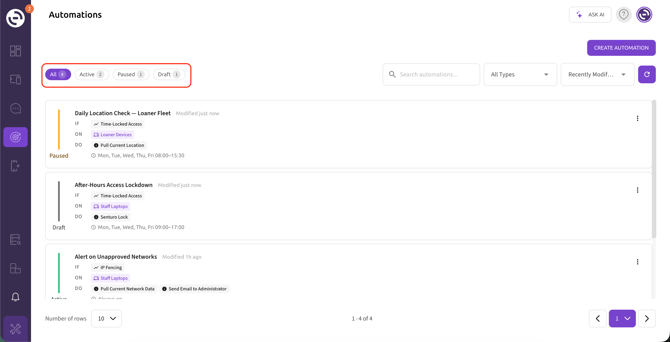
You set the initial status when you save. Save & Activate creates an Active automation; Save as Draft creates a Draft. The status filter chips at the top of the list show a count for each state, so you can see at a glance how many automations are live, paused, or unfinished.
Understanding Compliance: All Compliant vs. Non-Compliant
Each automation card shows a live compliance indicator with two states. When every device in scope currently satisfies the trigger condition, the card shows All compliant in green. When one or more devices are in breach, it shows a red non-compliant count — the number of devices in the automation's scope that are currently violating the trigger condition, right now, at this moment.
For example, an automation triggered by Outside Geofence shows All compliant when every in-scope device is inside the geofence, and a non-compliant count equal to the number of in-scope devices that are outside the geofence at present. As devices move back inside, the count drops (and returns to All compliant when none remain in breach); as devices leave, it rises.
A few things to keep in mind:
- It's a live snapshot, not a history. The count reflects the present state of your devices, not a log of how many times the automation has run or how many actions have been taken.
- A non-zero count isn't necessarily a problem. It simply tells you how many devices meet the trigger condition. Whether that's expected depends on your policy.
- It's a useful sanity check. After creating an automation, the count is a quick way to confirm the automation is scoped and configured the way you intended.
Reading an Automation at a Glance
Each card summarizes the automation without opening it:
- Name — the automation's name.
- Compliance indicator — All compliant (green) when no in-scope device is in breach, or a red non-compliant count of devices currently violating the trigger.
- Trigger, actions, device scope, and schedule — the card lays out the automation's logic (its trigger, what it does, which devices it applies to, and when it runs).
- Status — Active, Paused, or Draft.
- Last modified — when the automation was last changed.
Finding Automations
As your list grows, use the controls at the top of the Automations list to narrow it down:
- Status filter chips — click on All, Active, Paused, or Draft to filter by state.
- Search — enter an automation's name in the search field to jump to it.
- Filter by type — use the type filter to show only automations of a particular kind.
- Sort — reorder the list (for example, by most recently modified).
- Rows per page — adjust how many automations appear per page, and use the pagination controls to move between pages.
Managing an Automation
From the Automations list you can act on an individual automation using its menu (the ⋮ control on the card). Typical management tasks include:
- Editing an automation to change its trigger, actions, devices, or schedule.
- Duplicating an automation to create a copy you can modify — useful for building a set of similar automations, or for adapting one automation to a different device group.
- Pausing an Active automation (moving it to Paused) so it stops running without being deleted.
- Activating a Paused automation to make it Active again.
- Deleting an automation you no longer need.
Troubleshooting
My automation shows a high non-compliant count. This means many in-scope devices currently meet the trigger condition (for example, many devices are outside the geofence right now). It's a live count of devices in breach, not an error. Confirm the automation's device scope and trigger are what you intended.
I paused an automation, but it still shows a non-compliant count. Compliance is evaluated independently of whether the automation is running. Pausing stops the actions from executing; it does not stop Senturo from evaluating which devices meet the trigger condition, so the count continues to update.
I can't find an automation in the list. Check that you're on the right status filter chip — a new automation saved as a draft appears under Draft, not Active. Use the search field or clear the type filter to widen the results.
My automation isn't doing anything. Confirm its status is Active (not Draft or Paused), and that the current time falls within its schedule. See How to Create a Security Policy Automation for the full checklist.
Conclusion
The Automations list is your control center: statuses tell you what's running, the non-compliant count tells you how many devices are in breach right now, and the search, filter, and sort controls help you find any automation quickly. Together they let you keep a large set of automations organized and under control.
FAQs
Q: What does the non-compliant count mean? A: It's the number of devices in the automation's scope that are currently violating the trigger condition. It's a live snapshot of devices in breach at this moment, not a record of past actions.
Q: What's the difference between Paused and Draft? A: A Paused automation is complete and was activated at some point but is temporarily not running. A Draft has never been activated. Neither runs until you make it Active. Note that activating a draft is one-way — afterwards you can pause the automation, but you cannot move it back to Draft.
Q: Does pausing an automation delete it? A: No. Pausing stops the automation from running but keeps its configuration. You can resume it at any time to make it Active again.
Q: How do I find one automation among many? A: Use the status filter chips to filter by state, the search field to find it by name, the type filter to narrow by kind, and the sort control to order the list.
Q: Why is my automation's non-compliant count changing on its own? A: Because it reflects the current state of your devices. As devices move in or out of the trigger condition (for example, in and out of a geofence), the count updates to match.